
The Lancaster site has become a lively gathering place with the help of the civil engineers. The refurbished plaza hosts events and offers a welcoming environment for residents and visitors.
Near the Queen Street entrance of Lancaster’s Ewell Plaza, a striking statue of the site’s namesake, the city’s own 1948 gold and dual silver Olympic medalist Barney Ewell, depicts the sprinter leaning forward mid-stride. To the north, a porch-style swing structure offers a relaxing place to sit and take in the hustle and bustle of downtown Lancaster.
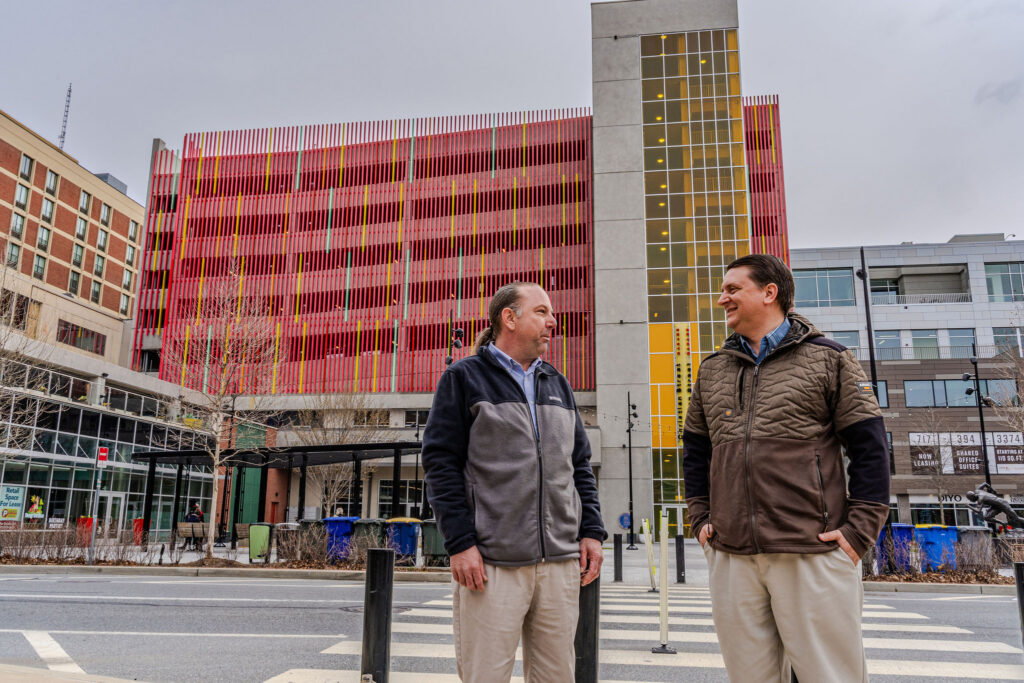
Pockets of green space soften the urban hardscape, complemented by a mix of seating platforms and open gathering areas that encourage people to linger. Anchoring it all is the front entrance of the Lancaster Public Library, surrounded by “The New Lancaster Rainbow,” a public art installation composed of over 100 colorful aluminum tubes measuring more than 70 feet long.
While the refurbished plaza is defined by its inviting design, much of the work toward achieving that result, performed by civil engineering firm C.S. Davidson, lies out of sight.
Engineering what you don’t see
Long before artwork and sculpture graced the plaza, the C.S. Davidson team was laying the groundwork for the project beneath the site.
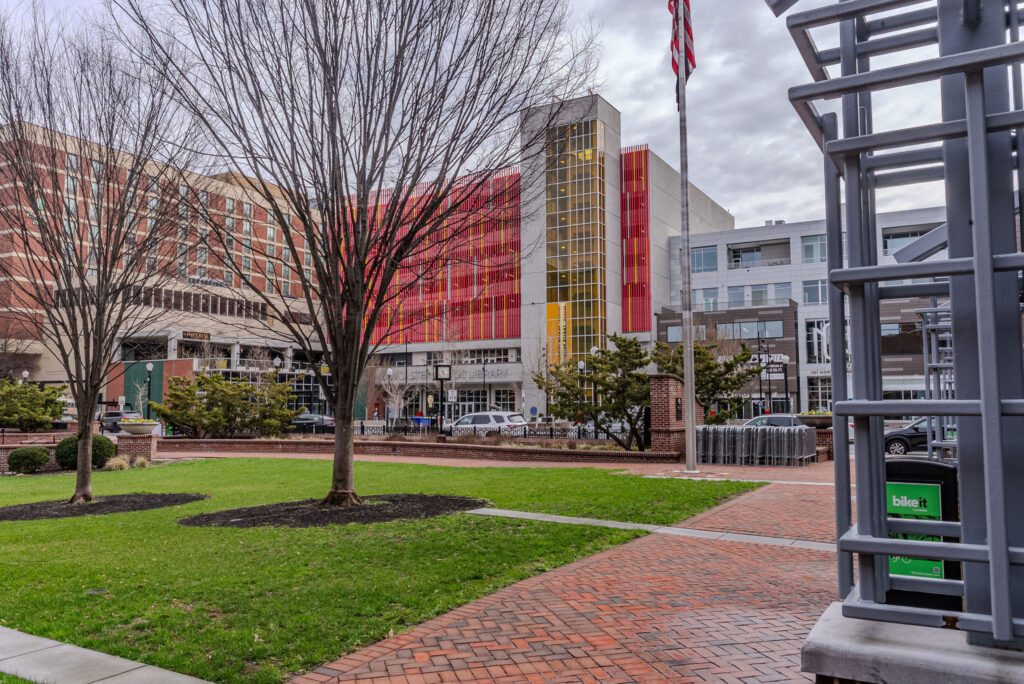
“We were involved in the stormwater management and the utility layouts,” says C.S. Davidson Project Manager Jason Wolfe, Registered Landscape Architect.
Beneath Ewell Plaza is a large stormwater chamber system spanning much of the site that is designed to manage runoff efficiently while reducing strain on the city’s public sewer. The system includes carefully engineered soils to regulate water infiltration and flow combined with dozens of interconnected chambers that store and gradually release stormwater.
While urban surfaces such as the plaza often fail to allow rainwater to drain rapidly, Ewell Plaza presented the opposite problem. Old construction debris underground was causing water to filter through too quickly.
“We were getting something like 100 and some inches an hour of infiltration,” Jason says. “Per the regulations, the maximum is 10 inches per hour, so we had to engineer soils that would slow down the infiltration.”
Sustainable design
Sustainability is thoughtfully built into Ewell Plaza in ways most visitors never notice. Beneath the surface, rainwater captured and stored by the chambered system and a cistern. The cistern is used to irrigate the plaza’s plantings. This helps reduce reliance on the city’s water supply while keeping the space green and vibrant.
That same functionality is at work above ground, where a green roof, planted with hardy, low-maintenance vegetation, absorbs rainfall and reduces runoff. The goal was to support Lancaster’s commitment to managing stormwater on-site as much as possible while using what could be a wasted resource to sustain some of the plaza’s features.
Structural details that bring the space to life
While Jason oversaw the installation of underground water-management and utility systems, Senior Project Engineer Wesley Werner, PE, designed the foundations for several key features on the plaza.
The first was a base for the Ewell statue. With Ewell’s likeness frozen in a sprint, the off-balance structure required a carefully engineered base to ensure stability.
Wesley also designed the foundation for the triple porch swing, light poles throughout the plaza, and other site features that contribute to its character and function.
A unique urban park experience
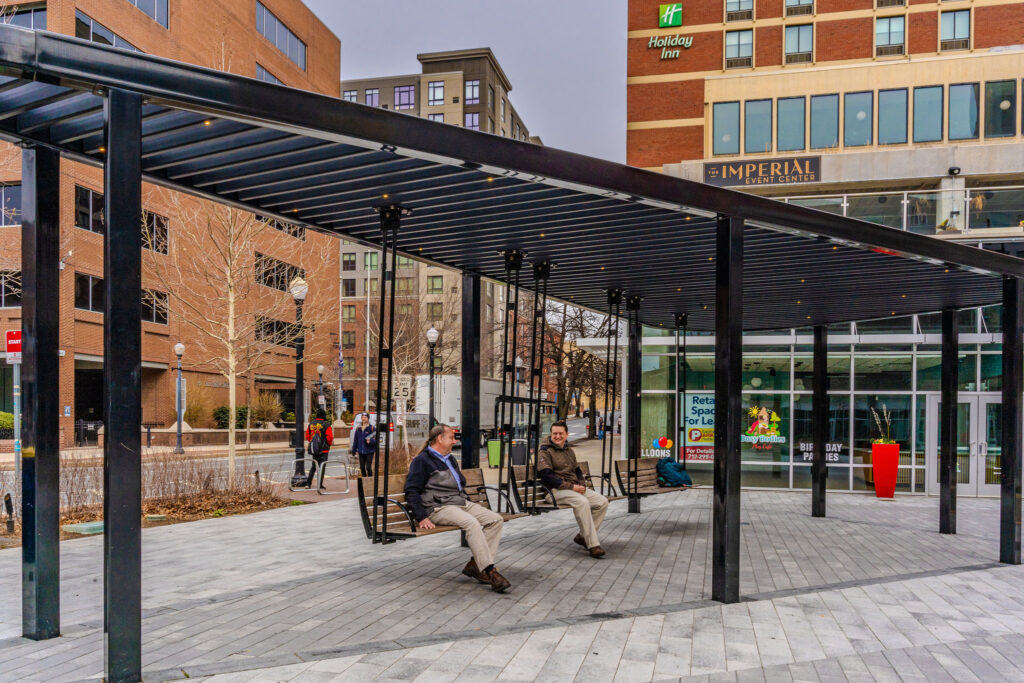
Unlike traditional parks, Ewell Plaza, which is surrounded by structures on three sides and a busy street on the fourth, reflects the realities of building in a dense urban environment. With limited available land downtown, every square foot had to be sensibly designed. The result is a space that prioritizes community use rather than having expansive green areas.
“This is a very urban park,” Jason says. “It’s almost all gathering space.”
The plaza also ties into nearby locations, including Binns Park just across Queen Street. That proximity allows the two spaces to function together during events.
Seeing the impact of the work
For Wesley and Jason, what has been most rewarding is witnessing how the community uses the renewed space.
“It was aprime area for redevelopment that nobody was using, and now it serves a key purpose in the community,” Jason says.
Wesley, whose Lancaster-based office is just a short walk away, experiences that impact regularly.
“I used to go by it, and it was just a construction fence and was all boarded up,” he says. “Now you go through it, and you see people enjoying it. That’s kind of the neat part to me.”
From its initial design in 2020 through completion in 2023, Ewell Plaza evolved from an underutilized block into a community-focused concept and downtown cornerstone. For Jason, that transformation is what makes projects such as this meaningful.
“It’s one thing to design it,” he says, “but then once you see that project come to life, that’s where I get the most enjoyment.”